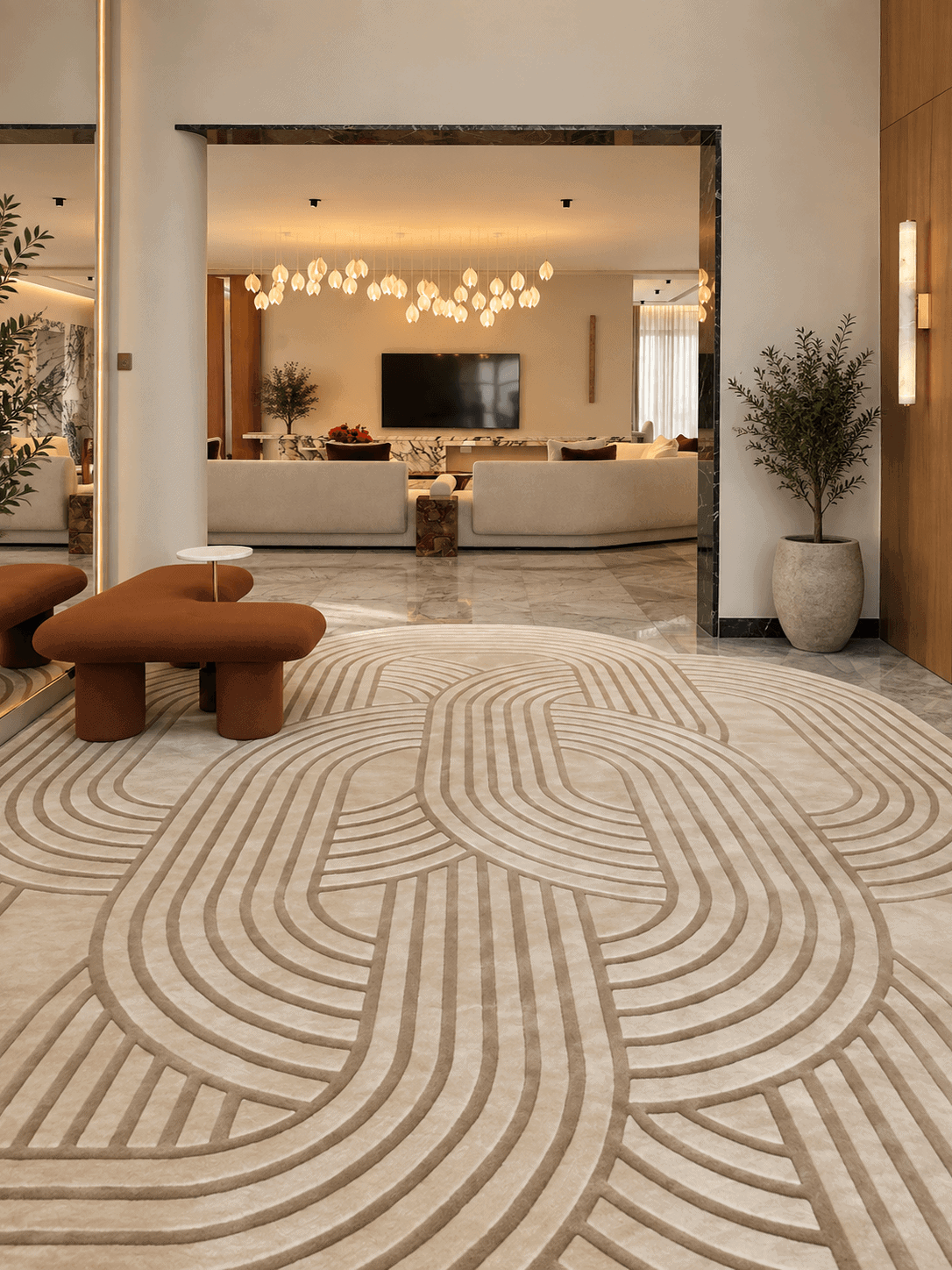
A rug might appear late in a project’s drawing package, but its success depends on decisions made much earlier. Its dimensions affect circulation. Its thickness meets door thresholds. Its colours sit beside stone, timber, and upholstery that have already been selected. A small change in any of these details can disturb an otherwise carefully resolved interior.
That is why choosing among architectural carpet manufacturers deserves the same attention as selecting a joinery or specialist lighting partner. For lead architects, the right relationship is not simply about purchasing a carpet. It is about finding a team that can translate design intent into a physical product, then help carry that intent through approvals, production, and installation.
Why Direct Manufacturing Relationships Matter
When specifications pass through several intermediaries, even straightforward questions can take too long to answer. Can a curve be softened without changing the footprint? Will the proposed fibre behave well in a busy lobby? What happens if the approved colour needs adjustment after the first sample?
Working directly with architectural carpet manufacturers creates a shorter conversation between the design team and the people responsible for making the rug. Material limitations become clearer, technical queries reach the right specialists, and decisions can be documented before they become expensive site problems.
A capable B2B custom rug studio should act as a design collaborator, not merely a catalogue of patterns.
Start with the Architectural Intent
Before discussing price, share the story of the space. Is the rug intended to anchor a seating group, soften a long circulation route, or create a focal point beneath a sculptural light fitting? Is visual symmetry essential, or does the furniture demand an intentionally off-centre composition?
Experienced architectural carpet manufacturers can respond more intelligently when they understand the purpose behind a drawing. Provide the floor plan, furniture layout, relevant elevations, and any material palette already approved. Identify areas where the rug must align with joinery, columns, or flooring joints.
A rendered image helps communicate atmosphere, but dimensioned drawings are what protect the geometry.
Translate Artwork into a Buildable Specification
Beautiful artwork is not automatically ready for production. A sweeping line that looks effortless on screen may need careful adjustment to remain crisp in tufted yarn. Tiny details may disappear at the chosen pile height, while intricate colour transitions can affect manufacturing complexity.
Ask architectural carpet manufacturers to review the artwork at its intended finished size. Confirm the overall dimensions, construction, fibre composition, pile height, colour references, border widths, and edge treatment. On irregular shapes, include reliable reference points and radii rather than relying on a perspective rendering.
Keep a clearly numbered drawing revision and an approved specification. These two documents should describe the same rug, not slightly different versions of it.
Select Materials for the Actual Environment
An executive lounge and a hotel corridor may share an aesthetic, but they rarely share the same performance needs. Foot traffic, wheeled movement, cleaning practices, sunlight, moisture, and acoustics all influence material selection.
Reputable architectural carpet manufacturers should explain the trade-offs between construction methods and fibres. Wool is often valued for its resilience and rich appearance. Silk and regenerated cellulose fibres, such as viscose or Tencel, can provide lustre but may be inappropriate where spills or heavy abrasion are expected. Pile density, backing, and finishing also matter.
Ask for relevant technical information rather than relying on words like “premium” or “commercial grade.” Where fire performance or other testing is specified, confirm that the proposed construction and applicable test evidence meet the project’s requirements.
Treat Sampling as a Design Stage
A digital colour is only a starting point. Yarn can look different under daylight and warm interior lighting. Cut and loop effects alter how shadows fall. A subtle tonal variation may be far stronger across a large floor area than it appears on a monitor.
For this reason, architectural carpet manufacturers should offer a defined sample and approval process. Agree on sample dimensions, which details it must demonstrate, and who has final sign-off. Review samples alongside the actual stone, wood, and fabric finishes wherever possible.
Record comments precisely: “reduce contrast between these two yarn colours” is more useful than “make it softer.” Approve a physical reference sample when practical, and retain it for comparison during production.
Ask How Quality Is Controlled
Handmade does not mean uncontrolled. It means the manufacturing process requires skilled judgement supported by consistent checks.
When evaluating architectural carpet manufacturers, ask who reviews the artwork before production, how colours are matched against approved references, and what inspections take place before packing. Clarify how deviations are identified and resolved, particularly for large or complex commissions.
Discuss acceptable manufacturing tolerances in advance. A handmade textile should not be treated like a machined metal component, yet its dimensions must remain compatible with the site. Clear tolerances protect both the architect’s design and the manufacturer from unrealistic expectations.
Plan Installation Before the Rug Arrives
The handover does not begin when the rug reaches the building. It begins when access, substrate readiness, furniture coordination, and final positioning are considered.
Good architectural carpet manufacturers will want to know about lifts, stairs, narrow entrances, flooring transitions, and any unusually large single-piece rugs. The appropriate underlay and edge details should be agreed in relation to the carpet construction and floor finish.
For projects with tight clearances or complex geometry, request a site measurement and an installation method appropriate to the conditions. A beautifully made rug can still disappoint if it sits crooked, ripples, or interrupts a doorway.
Make the Commercial Conversation Transparent
Architects need predictability, not just an attractive square-metre rate. A quotation should explain what is included: design development, sampling, manufacture, packing, shipping, delivery, underlay, and installation, as applicable.
Ask architectural carpet manufacturers to distinguish estimated lead times from confirmed production schedules. Establish the dates for drawing approval, sample sign-off, production release, and site readiness. Understand how design revisions affect cost and programme.
A reliable B2B custom rug studio should also communicate problems early. Timely, specific updates allow the project team to protect other trades and manage expectations with the client.
Choose a Partner Who Thinks Like Your Team
The strongest partnerships are built around questions, not quick promises. Does the studio challenge a material choice when maintenance will be difficult? Can it explain how an organic shape will be translated into a production drawing? Does it understand that a few centimetres may matter beside a perfectly aligned wall panel?
These are meaningful ways to compare architectural carpet manufacturers. Look beyond photographs of finished projects. Consider technical communication, sample accuracy, manufacturing oversight, and willingness to coordinate with your design and site teams.
Designing with KAYRA Bespoke
At KAYRA Bespoke, we work with architects and interior designers to develop handmade carpets and rugs around individual project requirements. Our Dubai-based design coordination and manufacturing expertise support conversations about artwork, dimensions, materials, finishes, and practical execution.
For architects seeking a B2B custom rug studio, the goal is a considered process: protecting the design from first drawing to final placement.
Because a rug should never feel like the last object added to a room. It should feel like part of the architecture from the beginning.
Explore bespoke carpet solutions at www.kayra.ae.