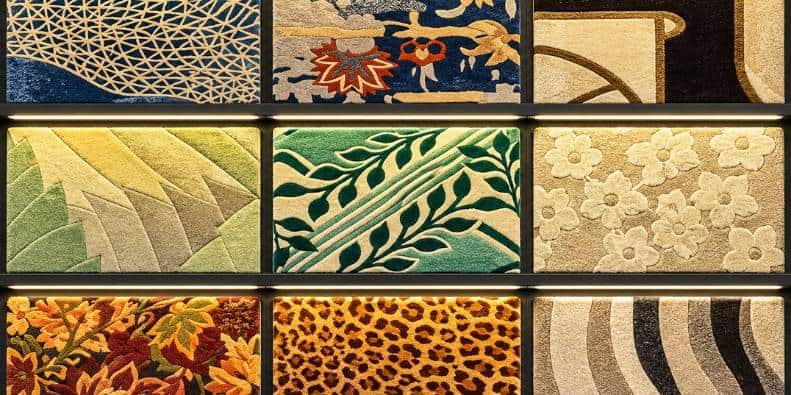
A beautiful rug can begin with a single material swatch on a designer’s desk. Perhaps it is a warm ivory that must sit comfortably beside limestone, or a muted blue chosen to echo a piece of artwork. On a mood board, the relationship looks effortless. In the finished interior, however, even a small difference in shade, sheen, or pattern placement can change the intended effect. That is why true to sample custom rugs require more than an attractive design and a final inspection. They depend on a clear approval process connecting the mood board, physical sample, production team, and completed rug.
For interior designers managing demanding residential and hospitality projects, the objective is consistent reproduction of an approved reference, with any unavoidable handmade tolerances understood before manufacturing begins.
1. Translate the Mood Board into Measurable Requirements
Mood boards express atmosphere, but they do not always define manufacturing instructions. A photograph might communicate the right beige without identifying its undertone. A rendering may show a clean geometric border without specifying its width.
The first step towards true to sample custom rugs is translating those visual references into a technical brief. Record dimensions, materials, construction, pile heights, design orientation, and colour positions. Supply artwork files and drawings at an agreed scale.
Where a precise relationship matters—for example, between the rug border and a nearby marble joint—show it clearly on the drawing. The more a manufacturer understands about the design intent, the less room there is for interpretation.
2. Confirm What Matching Really Means
Designers sometimes request a perfect match to a digital image. Yet screens, printed sheets, dyed fibres, and finished carpet piles all reflect or display colour differently. A colour code is useful as a starting reference, but it cannot fully describe how yarn will look in a finished surface.
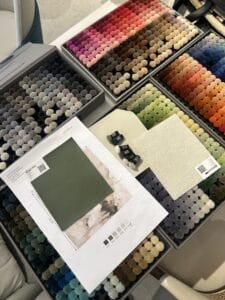
With true to sample custom rugs, the agreed physical sample should become the central visual reference. Specify which sample is approved, when it was approved, and which characteristics it controls.
This is particularly important when different teams review the same rug. Without a shared reference, one person may approve a colour based on a rendering while another judges it against a fabric swatch.
3. Review Yarn, Texture, and Pile Together
Colour cannot be separated from material. A matte wool yarn and a lustrous silk-like yarn can appear different even when their underlying colour is similar. Cut pile, loop pile, and carved details also affect light and shadow.
Successful true to sample custom rugs therefore require approval of texture as well as shade. A small yarn pom may help narrow a colour choice, but a tufted sample reveals how multiple colours and pile heights actually interact.
If the design uses high-and-low textures, check the height difference and definition of the pattern. For subtle gradients, examine whether transitions remain balanced rather than forming noticeable bands.
Explore: Hand-Tufted Rugs
4. Use Sampling as a Controlled Approval Stage
A sample is not simply a preview. It is an opportunity to test the manufacturing interpretation before committing to a full-size rug.
For true to sample custom rugs, a useful approval sample should represent the proposed construction, fibre mix, colours, and key design effects as closely as practical. On a highly detailed rug, a small sample may not contain enough of the pattern to demonstrate its overall rhythm. In such cases, a larger sample or additional detail panel may be valuable.
Record approval comments precisely. “Make it warmer” can be understood differently by different people. “Reduce the grey undertone in colour B and retain colour A unchanged” gives the manufacturer a clearer instruction.
5. Check Colour Under the Project’s Lighting
A sample can look correct in the design studio and noticeably different on site. Daylight, warm LEDs, and directional lighting alter how tones are perceived. The direction of the pile can also make one side of a rug look lighter than the other.
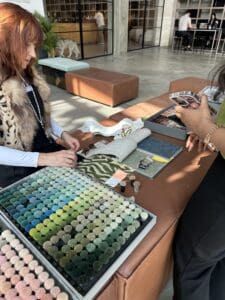
For true to sample custom rugs, review samples in relevant lighting conditions and against adjacent finishes wherever possible. Move the sample through the intended space and examine it from the main viewing directions.
The demand for exact color match bespoke rugs is best approached as a controlled comparison under agreed conditions, not a promise that a textile will look identical at every hour of the day.
6. Create an Approved Master Reference
Once the designer signs off, the manufacturer and project team need to know which sample governs production. Informal approvals buried in message threads can create avoidable confusion.
A sound process for true to sample custom rugs includes a labelled master sample, revision number, date, and written approval. Keep accompanying specifications and artwork aligned with that version. If a later change affects the yarn, shade, or pattern, update the reference rather than relying on an earlier approval.
Where possible, retain matching reference samples with both the design team and production team. This creates a shared standard for reviewing the completed carpet.
7. Monitor Quality During Production
Waiting until dispatch to check a rug leaves little time to resolve problems. Quality control should happen at relevant stages of manufacture.
With true to sample custom rugs, checks may include yarn shade against approved references, pattern positioning, dimensions, pile consistency, workmanship, and finishing. Where multiple rugs are being made for one project, consistency between pieces also needs attention.
Handmade production naturally involves small variations. That is different from an avoidable error such as using the wrong colour or missing an agreed border. Clear inspection points help teams recognise the difference and respond before a deviation becomes harder to correct.
Read More: Bespoke Carpet Manufacturing
8. Define Tolerances Before They Become Disputes
“Zero deviation” may describe the creative ambition, but it is not a realistic universal manufacturing guarantee for handmade textiles. Yarn behaviour, finishing, and construction can introduce controlled dimensional or visual variation.
The responsible approach to true to sample custom rugs is to agree in writing what matters most and what tolerances are acceptable. State critical dimensions, colour approval criteria, and how the rug will be assessed. Identify any design elements where a small shift would be especially noticeable.
For buyers seeking exact color match bespoke rugs, transparency about materials and inspection conditions gives more protection than a vague promise of perfection.
9. Inspect the Finished Rug Against the Right Standard
Before packing, the finished rug should be examined alongside the approved reference and technical documents. Check the design orientation, dimensions, colour placement, pile variation, edges, backing, and overall finish.
A final review of true to sample custom rugs should also consider whether the rug reads correctly as a complete composition. An approved small swatch cannot always reveal how repeated motifs or gradients appear across several metres.
Photographs and videos can support remote approvals, but camera settings and lighting may distort colour. When shade is critical, physical comparisons or an agreed on-site review remain important.
Explore: Bespoke Carpet Projects
10. Make Delivery and Installation Part of Quality Assurance
Quality does not end when the rug leaves the factory. Creasing during handling, unsuitable site conditions, or incorrect positioning can affect the final impression.
For true to sample custom rugs, confirm access, floor readiness, underlay requirements, orientation, and alignment before installation. Once placed, review the rug with the furniture layout and relevant architectural lines.
A carefully manufactured piece only fulfils its purpose when it sits as the design intended. The last check should therefore focus on the finished room, not just the product in isolation.
Partner with KAYRA Bespoke for Design-Led Precision
At KAYRA Bespoke, we understand how much thought designers invest in a colour palette, drawing package, and material selection. Our approach to customised handmade carpets and rugs brings design development, sampling, manufacturing coordination, and finishing considerations into one conversation.
The goal of true to sample custom rugs is to protect that original vision through documented decisions, clear communication, and meaningful quality checks. While handmade materials must be assessed with realistic tolerances, care at each stage helps reduce surprises and support a more confident approval process.
A bespoke rug should not ask the room to compromise. It should respect the details that made the interior worth designing.
Explore bespoke carpet solutions at www.kayra.ae.