
Commercial interiors demand far more from a carpet than simply looking good. In hotels, corporate offices, restaurants, retail spaces, lounges, and other high-traffic environments, flooring becomes part of the overall design language of the project. It must complement the interior concept, perform reliably, meet project specifications, and create the right impression for guests, customers, and employees.
This is where commercial bespoke carpets make a significant difference.
Unlike standard ready-made carpets, bespoke carpets are developed specifically for a project. Their dimensions, colours, patterns, materials, textures, and construction can all be customised around the designer’s vision and the practical requirements of the space.
At KAYRA, we work closely with interior designers, architects, FF&E teams, procurement companies, developers, hospitality groups, and contractors to transform design concepts into individually crafted carpets and rugs for commercial interiors.
Why Bespoke Carpets Matter in Commercial Interior Design
Every commercial project has its own identity.
A luxury hotel lobby may require a statement carpet that immediately creates a sense of arrival. A fine-dining restaurant may need something sophisticated but understated. Corporate offices often require carpets that complement the company’s visual identity, while hospitality suites and lounges may call for softer textures and more refined detailing.
Standard rugs can sometimes fulfil a functional requirement, but they rarely provide complete creative freedom.
With commercial bespoke carpets, designers can control almost every visual and technical element of the finished product.
This includes:
- Custom dimensions and shapes
- Bespoke colour combinations
- Artwork developed specifically for the project
- Custom pile heights
- Carved and sculpted textures
- Material combinations
- Border and edge detailing
- Gradient and abstract patterns
- Geometric or organic designs
- Project-specific construction and finishing
The result is a carpet that feels like an integral part of the interior rather than an accessory added at the end.
From Interior Concept to Finished Carpet
Creating a bespoke carpet for a commercial project usually begins with the interior design concept.
Sometimes our clients provide detailed carpet artwork. In other cases, they may provide an inspiration image, material palette, fabric reference, architectural detail, or even a simple sketch.
Our design team studies the concept and develops carpet artwork that can be translated into production.
The design development stage is particularly important because an artwork that looks beautiful on a computer screen still needs to work as a physical carpet.
Lines may need to be refined, colours carefully selected, details adjusted for production, and different pile heights introduced to create depth.
Rather than simply reproducing an image, the objective is to understand the designer’s intention and interpret it correctly through yarn, texture, construction, and craftsmanship.
Colour Matching for Commercial Projects
Colour is often one of the most sensitive elements of a bespoke carpet project.
Interior designers typically work with carefully coordinated palettes involving stone, timber, wall finishes, upholstery, curtains, metal finishes, and decorative materials. The carpet needs to sit comfortably within this overall palette.
For this reason, colour development is an essential part of our process.
Yarn shades can be selected against colour references, pom samples, fabrics, or other approved project materials before production begins.
Lighting also plays an important role.
Natural daylight, warm architectural lighting, and cooler artificial lighting can make the same yarn appear slightly different. Experienced B2B luxury carpet suppliers therefore look beyond a simple digital colour reference and consider how the finished carpet will actually appear within the space.
Sampling provides the design and project teams with an opportunity to review colours, construction, pile height, and texture before moving into full production.
Choosing the Right Materials
A successful commercial carpet should balance design, comfort, appearance, and durability.
Material selection therefore depends on where the carpet will be installed and how the space will be used.
New Zealand wool remains a popular choice for luxury commercial interiors due to its natural appearance, resilience, comfort, and premium feel.
Other projects may incorporate materials such as nylon, Tencel, silk, or blended fibres to achieve specific textures and visual effects.
For example, combining wool with a lustrous fibre can create subtle contrasts between matte and reflective areas. This becomes particularly effective in abstract patterns, tone-on-tone designs, and carpets that rely on texture rather than strong colour variation.
The right material should never be selected purely on appearance. Traffic levels, maintenance expectations, furniture placement, lighting, project budget, and intended application should all be considered.
Hand-Tufted Carpets for Commercial Interiors
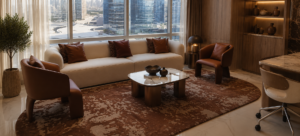
Hand-tufted carpets are widely used across luxury commercial and hospitality projects because they offer substantial design flexibility.
They allow designers to experiment with custom patterns, irregular shapes, multiple colours, carving, different pile heights, and combinations of materials.
Large rugs can be developed for hotel lobbies, reception areas, suites, offices, meeting rooms, restaurants, majlis spaces, and other statement areas.
Depending on the design, a hand-tufted carpet can appear highly decorative or extremely minimal.
A single-colour rug, for example, can become visually interesting by introducing subtle differences in pile height or fibre texture. Conversely, a detailed carpet may combine multiple colours and sculptural elements to create a strong focal point.
This flexibility makes hand-tufting particularly suitable for commercial bespoke carpets where the flooring needs to follow a specific interior concept.
Hand-Knotted Carpets for Exclusive Spaces
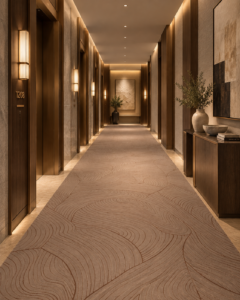
For highly exclusive projects, hand-knotted carpets offer another level of craftsmanship.
Each knot is individually created by skilled artisans, resulting in a carpet that requires significant time and expertise to produce.
Hand-knotted rugs are particularly suited to executive spaces, presidential suites, private dining areas, luxury residences within mixed-use developments, exclusive hospitality areas, and interiors where craftsmanship forms an important part of the design narrative.
The production method, knot density, material, and complexity of the artwork all influence the finished result.
While the process is considerably more time-intensive than many other carpet constructions, the final piece carries the distinctive character of genuine handmade craftsmanship.
Custom Sizes and Shapes
Commercial interiors rarely follow standard rug dimensions.
Architectural layouts may contain curved walls, columns, recessed seating arrangements, large open spaces, or furniture configurations that require carpets to be made to very specific measurements.
Bespoke manufacturing allows rugs to follow these conditions more accurately.
Carpets can be developed as rectangular, circular, oval, free-form, or irregular shapes depending on the interior design.
This is especially useful for hospitality and high-end commercial environments, where the rug may need to align precisely with furniture, architectural features, or a defined seating zone.
Accurate dimensions also help create a more intentional relationship between the carpet and the surrounding interior.
Hospitality Carpets That Support the Design Story
Hospitality interiors are designed around experiences.
From the moment a guest enters a hotel lobby to the time they reach a suite, restaurant, lounge, or private area, every surface contributes to how the space feels.
Carpets play an important role because they add warmth, softness, acoustic comfort, colour, and visual identity.
Bespoke carpets can also reference elements from the surrounding architecture or destination.
A pattern might be inspired by local landscapes, natural stone, water movement, architectural geometry, traditional motifs, or artwork used elsewhere in the property.
Through careful interpretation, these influences can be transformed into contemporary carpet designs rather than literal decorative reproductions.
This allows the flooring to support the overall design story of the project.
Working with Designers, Architects and Procurement Teams
Commercial projects involve several stakeholders, and successful carpet manufacturing requires clear communication between them.
As B2B luxury carpet suppliers, we understand that designers, consultants, procurement teams, contractors, and end clients may each have different priorities.
Designers are primarily focused on achieving the intended appearance.
Procurement teams need clear pricing, specifications, quantities, and delivery information.
Consultants may require technical documentation and material information.
Contractors need accurate site dimensions, installation coordination, and practical information regarding floor preparation.
Managing these requirements carefully helps reduce misunderstandings and keeps the carpet package aligned with the wider project programme.
Sampling Before Production
Samples are one of the most important stages in a bespoke carpet project.
A sample allows the project team to evaluate the actual yarn colours, texture, construction, carving, pile height, and design proportions.
Digital artwork can communicate the overall concept, but physical sampling provides information that simply cannot be judged accurately from a screen.
Once a sample has been reviewed, comments can be incorporated before bulk production begins.
This approval process is particularly valuable for complex commercial projects where multiple carpet designs or significant quantities are involved.
Quality Control During Manufacturing
Bespoke carpet manufacturing requires attention at every stage.
Once production begins, the carpet moves through several processes including yarn preparation, tufting or knotting, carving, finishing, washing where applicable, stretching, backing, edge finishing, inspection, and packing.
Quality control is not simply a final inspection.
It should form part of the complete manufacturing process.
Design proportions, yarn colours, pile consistency, dimensions, finishing, and overall appearance all need to be checked before a carpet is released for delivery.
For commercial projects, careful quality control becomes particularly important because carpets are often being coordinated with installation programmes and project handover schedules.
Installation Is Part of the Final Result
Even a beautifully manufactured carpet can lose its visual impact if it is installed incorrectly.
Large or irregular carpets require careful handling, positioning, alignment, and finishing on site.
The condition of the floor also matters.
The substrate should be suitably prepared, level, clean, and ready to receive the carpet before installation.
Furniture positioning, architectural obstacles, stairs, recessed areas, and other site conditions should ideally be reviewed in advance.
For bespoke projects, manufacturing and installation should therefore be considered as connected parts of the same process rather than completely separate activities.
Why Businesses Choose Bespoke Carpet Manufacturers
Working directly with an experienced bespoke carpet manufacturer gives commercial clients significantly more flexibility than selecting from standard collections.
It enables the project team to develop flooring around the interior rather than designing the interior around an existing carpet.
For designers, this means greater creative freedom.
For developers and hospitality operators, it means the opportunity to create spaces with a distinctive identity.
For procurement teams, working with experienced B2B luxury carpet suppliers can also simplify communication by bringing design development, sampling, manufacturing, quality control, delivery, and installation coordination into a more structured process.
Read more: Where to Source Custom Rugs in the UAE
KAYRA – Bespoke Carpets for Commercial Projects
Based in Dubai, KAYRA specialises in creating customised handmade carpets and rugs for residential, commercial, and hospitality interiors across the UAE and wider GCC region.
Our approach combines design development with artisan manufacturing, allowing us to work closely with architects, interior designers, FF&E teams, procurement companies, contractors, developers, and hospitality clients from the initial concept through to the finished carpet.
From sophisticated hand-tufted rugs to individually crafted hand-knotted pieces, every project is approached according to its own aesthetic and functional requirements.
We believe a bespoke carpet should do more than cover a floor.
It should belong to the architecture, complement the interior, and quietly strengthen the character of the space.
Looking for Commercial Bespoke Carpets?
If you are working on a hotel, restaurant, corporate office, retail environment, luxury development, or another commercial interior project, KAYRA can assist with the development of customised carpet solutions tailored to your project.
Share your drawings, artwork, colour palette, inspiration, or project requirements with our team, and we can help transform the concept into a bespoke handmade carpet designed specifically for your space.